
Co-Regulation: How Parents Build Self-Regulation in Kids
Co-regulation is the science-backed bridge between your child's big feelings and their lifelong ability to self-regulate. Here's how it works—and what to do tonight.
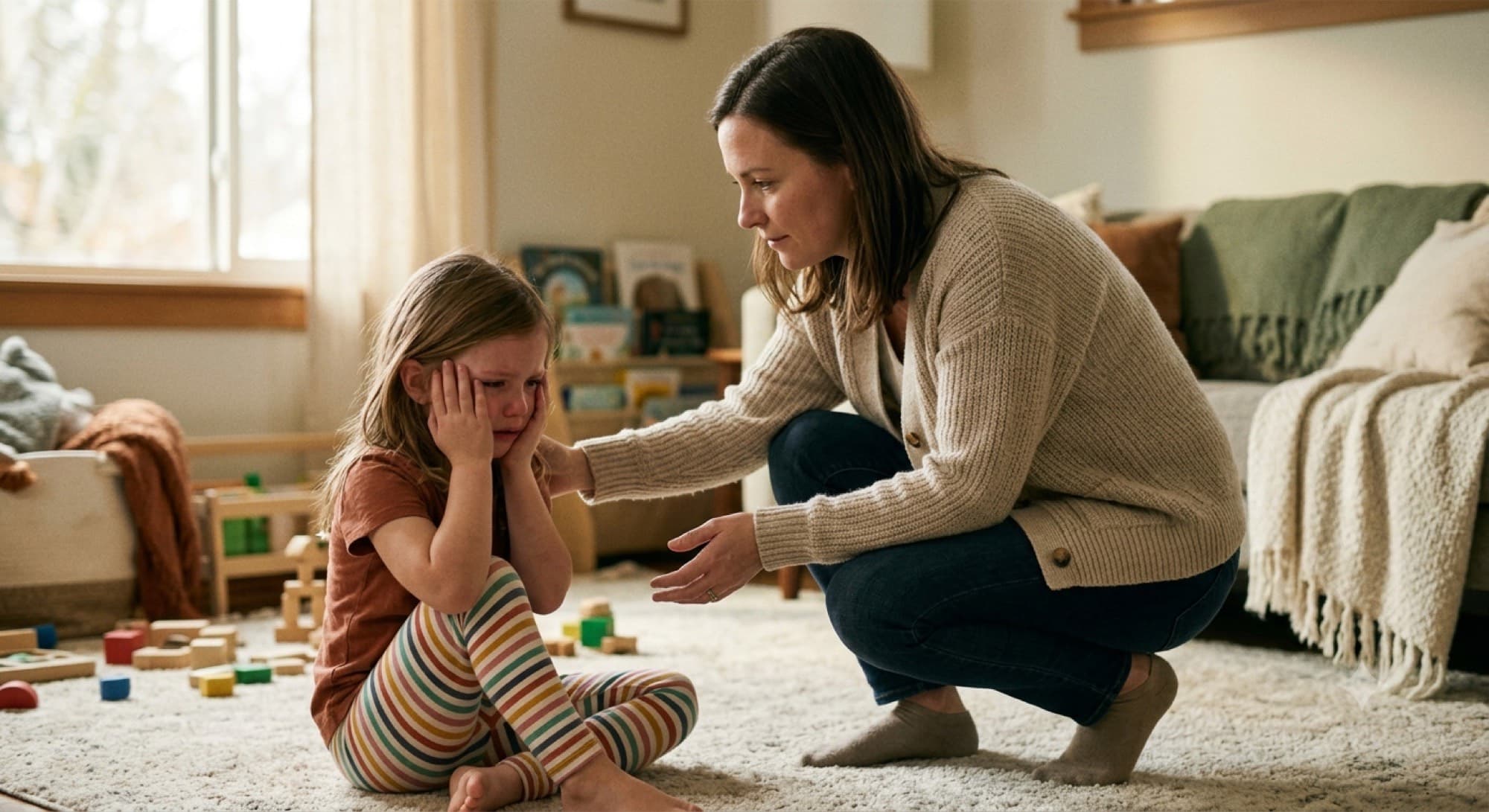
Quick answer: Co-regulation is how children learn to manage their emotions—by repeatedly borrowing a calm caregiver's regulated nervous system until their own brain is mature enough to do it alone. Research shows that warm, responsive co-regulation during emotionally difficult moments is one of the strongest predictors of healthy self-regulation later in childhood. Your calm is the lesson.
The Moment Nobody Prepares You For
You've had a version of this scene: it's 5:47 p.m., someone wanted the blue cup not the green one, and now the world is ending. Your four-year-old is on the floor. You're running on three hours of sleep and a lukewarm coffee. Every instinct is screaming just stop crying — and you feel quietly guilty that you can't say it nicely.
Here's the thing nobody tells you in that moment: your child is not choosing to be difficult. Their brain literally cannot do what you're asking. And the most powerful thing you can do right now has nothing to do with discipline, distraction, or negotiation. It has everything to do with you — and how you're feeling in your own body.
That's co-regulation. And it's the bridge between the meltdowns of today and the emotional resilience your child will carry for life.
Why Your Calm Is the Curriculum
The Prefrontal Cortex Problem
Here's the counterintuitive truth that changes everything: your child isn't refusing to calm down. They genuinely cannot — not yet. The prefrontal cortex, the part of the brain responsible for impulse control, emotional regulation, and rational decision-making, doesn't fully mature until around age 25. In a three-, four-, or five-year-old, it's barely online.
When a big feeling floods your child's system — the rage, the heartbreak, the bone-deep disappointment of a dropped ice cream cone — their limbic system (the emotional alarm centre) takes over. The thinking brain goes offline. No amount of "use your words" or "you're fine" reaches a brain in that state.
What does reach it? Your nervous system.
Borrowed Calm: The Science Behind Co-Regulation
Children are exquisitely attuned to the adults around them. Their nervous systems are constantly reading yours — scanning your tone of voice, your facial expression, the speed of your breathing. When you stay regulated in the middle of their storm, their body begins to take its cue from yours. Researchers call this co-regulation: the moment-to-moment, relational process by which a caregiver's calm presence helps a child's dysregulated nervous system find its way back to safety.
This is not a metaphor. It is a biological process. As developmental neuroscientists have confirmed, children depend on caregiver co-regulation during the early years while the prefrontal cortex and vagal system — the biological infrastructure of self-regulation — are still maturing through social interaction and repeated experience.
A 2024 systematic review published in Merrill-Palmer Quarterly (Verhagen, Boekhorst, & Kupper) found that co-regulation during challenging situations is strongly linked to improved self-regulation outcomes in children, particularly when the caregiver-child relationship is marked by flexibility, mutual responsiveness, and what researchers call "dyadic synchrony" — that in-tune dance of reading each other's cues. It's not the easy, calm moments that do the most developmental work. It's the hard ones, met with warmth.
Research by Armstrong-Carter and Sulik (2021) reinforces this: children who experience consistent co-regulation are more likely to develop healthier emotional awareness, fewer behavioural challenges, and more adaptive stress responses over time.
The Emotion Coaching Layer
Co-regulation doesn't stop at your breath and your presence. What you say in those moments matters too. Gottman's longitudinal research (Gottman, Katz, & Hooven, 1997) introduced the concept of emotion coaching — a parenting approach built on acknowledging and naming children's emotions rather than dismissing or punishing them. Subsequent studies confirmed that parental emotion coaching predicts better self-regulation skills in children across multiple measures (Gottman, Katz, & Hooven, 1996; Katz, Gottman, & Hooven, 1996).
The mechanism is elegantly simple. When you say "You're really frustrated right now, aren't you?" instead of "Stop crying," you do two things at once: you validate the feeling (which lowers threat in the nervous system) and you hand your child language for their inner world. Dr. Dan Siegel famously calls this "name it to tame it" — and there's real neuroscience behind the phrase. Labelling an emotion has been shown to measurably reduce activity in the amygdala, the brain's alarm system. Words, offered with warmth, are genuinely calming. (For a closer look at the framework behind this, see our post on emotion coaching.)
5 Ways to Co-Regulate in the Thick of It
You don't need a perfect script. You need a handful of anchors you can reach for when your own nervous system is doing its best. These steps work precisely because you're doing them alongside your child, not at them.
- Regulate yourself first. Before you respond, take one slow breath — in for four counts, out for six. Your child's nervous system is reading yours. A lowered, quieter voice signals safety; a sharp, tense one confirms the threat. This is not about being perfect. It's about being a little calmer than the room.
- Move toward, not away. A regulated presence — sitting close, making eye contact, or offering a gentle touch if your child accepts it — communicates safety at a physiological level. Connection is the on-ramp to calm.
- Name the feeling without fixing it. "You're so disappointed. You really wanted that." Full stop. You don't have to solve it, justify it, or talk them out of it. The act of being accurately seen is itself regulating.
- Match, then lead. Start by meeting your child where they are emotionally (acknowledging the intensity of the feeling), then gradually model a slower pace — lower voice, softer movements, steadier breathing. You're not dismissing the feeling; you're showing the way through it.
- Debrief when the storm has passed. Once everyone is calm — not during — you can gently revisit what happened. "That was a big feeling. What do you think might help next time?" This is where self-regulation skills are actively built: in the reflection after, not in the heat of the moment. For a deeper look at the full toolkit, 5 Co-Regulation Techniques Every Parent Should Know walks through each one with practical examples.
How Stories Build the Bridge
There's a reason bedtime stories have been the unofficial emotional debrief of childhood for centuries — and now there's research to back it up.
Reading picture books together is co-regulation. Sitting close, voices soft, bodies settled — it's the nervous-system equivalent of pressing "reset." But the right story does even more than that. When children encounter a character who feels the same big feelings they do and watches that character find a way through, they're not just entertained. They're learning. They're practicing — safely, at one remove — what it looks and feels like to move from overwhelmed to okay.
Research into narrative-based learning shows that children who see emotional regulation modelled by story characters can begin to apply those same strategies in their own lives. A character's journey through a big feeling gives the child mental scaffolding: a map they can reach for the next time their own emotional weather turns dark. This is the power of bibliotherapy, and it works hand in hand with the co-regulation you offer every day.
The story becomes a shared reference point. "Remember how Tembo felt that big rumble inside? What did Tembo do?" Now you're not just reading together — you're building the emotional vocabulary that makes self-regulation possible.
The bridge from co-regulation to self-regulation isn't built in a single calm-down. It's built moment by moment, across thousands of ordinary (and decidedly un-ordinary) interactions — each time you breathe before you speak, name the feeling before you fix the situation, or curl up together with a story about a character who knows exactly how your child feels.
You're not just surviving the hard moments. You're building something that lasts.
Frequently asked questions
1.What is co-regulation in parenting?
Co-regulation is the process by which a calm, present caregiver helps a child manage overwhelming emotions before they can do so independently. It's the foundation from which lifelong self-regulation grows.
2.At what age do children develop self-regulation?
Self-regulation develops gradually throughout childhood and into early adulthood. The prefrontal cortex—the brain's control center for impulse and emotion—doesn't fully mature until around age 25, which is why young children genuinely need adult support when big feelings hit.
3.How does co-regulation become self-regulation?
Through thousands of repeated co-regulatory moments, children gradually internalize the calming strategies their caregivers model. Over time, what began as borrowed calm becomes the child's own emotional toolkit.
4.What does co-regulation look like in practice?
Co-regulation can be as simple as sitting calmly next to a distressed child, softening your voice, naming their feeling aloud, and offering your steady presence—without trying to fix or stop the emotion.
5.Is co-regulating with my child the same as giving in or spoiling them?
No. Co-regulation builds the neurological scaffolding children need to become emotionally independent. Responding to big feelings with calm and empathy teaches self-regulation; it doesn't reward or reinforce the meltdown.

Ready to Create Your Child's Story?
Every Sprig book is personalized to your child's specific emotional needs — backed by the research you just read about.
Create Your Book